
World Map - Interrupted Mollweide Projection
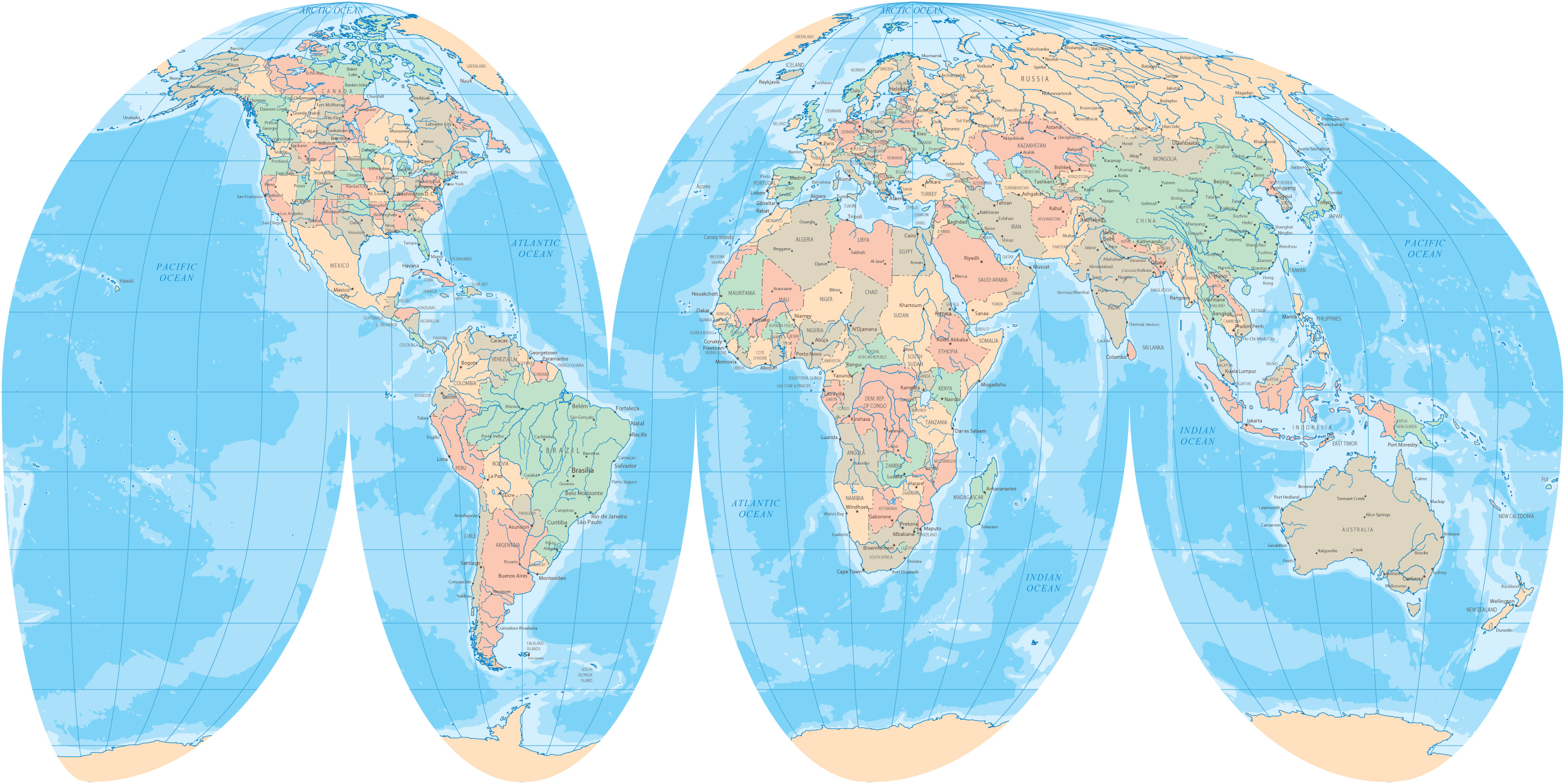
The Planet Earth has about 4.55 billion years old. The earliest usually accepted date for life appearing on Earth is 3.48 billion years ago.
There are estimated to be 7,168 living languages spoken in the world (2023); approximately 80% of these languages are spoken by less than 100,000 people; about 150 languages are spoken by fewer than 10 people; communities that are isolated from each other in mountainous regions often develop multiple languages; Papua New Guinea, for example, boasts about 840 separate languages (2018). Most-spoken language: English 18.8%, Mandarin Chinese 13.8%, Hindi 7.5%, Spanish 6.9%, French 3.4%, Arabic 3.4%, Bengali 3.4%, Russian 3.2%, Portuguese 3.2%, Urdu 2.9% (2022 est.). Most-spoken first language: Mandarin Chinese 12.3%, Spanish 6%, English 5.1%, Arabic 5.1%, Hindi 3.5%, Bengali 3.3%, Portuguese 3%, Russian 2.1%, Japanese 1.7%, Punjabi, Western 1.3%, Javanese 1.1% (2018 est.).
Religions: Christian 31.1%, Muslim 24.9%, Hindu 15.2%, Buddhist 6.6%, folk religions 5.6%, Jewish <1%, other <1%, unaffiliated 15.6% (2020 est.). Source: World Factbook 2024.



|
Copyright © Geographic Guide - Maps World, Mapa Mundi. |
All rights reserved |
World Map - Interrupted Mollweide Projection
◄ Maps